Reason DAW
I am a long-time user and fan of the Reason music production software. A key feature of Reason is virtual hardware rack where you can install various devices then press [Tab] to "flip the rack" and wire everything together:
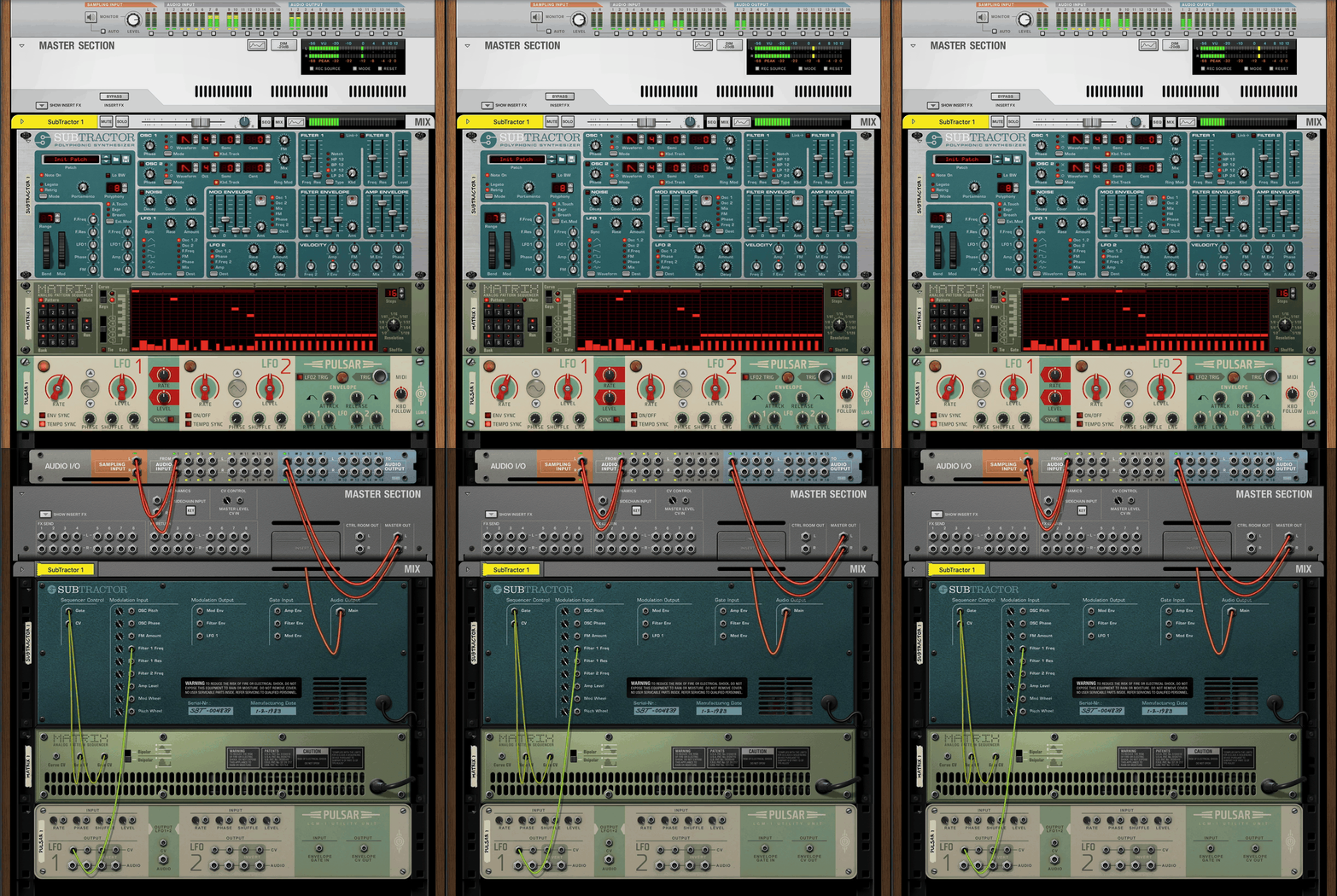
I've been using it since Reason 1 was released in 2000, and it remains one of my top "creative happy places" to this day. You can read a history of Reason on the Reason Studios website.
Here is the online manual.
The rest of this page is my "notes to self" about how to use it (on 🍏 MacOS).
Keyboard Shortcuts
🎹 Devices
| What | How |
|:-|:-|
| Browse patches | command + B |
| Create instrument from patch | command + I |
| Create effect | command + E |
| Duplicate track/device | command + D |
| Parameter Automation Shortcut | option + click control |
| Search devices | command + shift + F |
🎼 Sequencer
| What | How |
|:-|:-|
| Nudge (snap unit) | command + left/right |
| Nudge (beat) | command + shift + left/right |
| Nudge (tick) | command + option + left/right |
| Pencil tool: Edit velocity of selected only | command + shift + click |
| Merge note lanes on track | command + R |
| Quantize | command + K |
| Hand tool | U |
| Join clips | command + J |
🎚 Mixer
| What | How |
|:-|:-|
| Detach Main Mixer | command + F5 |
| Route to new output bus | command + G |
| Sort Rack devices by Mixer channel order | Edit > Sort Selected Device Groups |
⏯ Transport
| What | How |
|:-|:-|
| Set loop to clips and play |P |
| Set loop to clips | command + L |
| Set loop start | option + click in Timeline |
| Set loop end | command + click in Timeline |
| Go to start of song| numpad .
shift + return |
| Go to loop start/end | option + left/right |
🤷♂️ Misc
| What | How |
|:-|:-|
| Delete without confirmation | command + delete |
| Zoom in/out (horizontal) | H/G |
| Zoom to selection | Z |
| Zoom to max track height | shift + Z |
| Select previous/next clip | left/right |
Some fun facts
- Reason's main mixer is modeled on the SSL 9000 K
- There are lots of fun names for Reason devices. Some of my favorites:
- Redrum (a drum machine out to murder you!)
- ID8 (Ideate)
- RPG-8 (Arpeggiate)
- NN-19 (the average age of the combat soldier...)
My compressors
Summary:
| Archetype | Purpose | My Reason Device(s) |
|---|---|---|
| SSL bus VCA (SSL 400 G Series) | Lightly compress a bus to add cohesion/glue while preserving punch and transients | Master Bus Compressor, DCAM BusComp |
| Console VCA (SSL channel comp) | Tame dynamics on individual tracks without changing the tone | Channel Dynamics |
| Optical (LA-2A) | Smoothly level sustained sources (e.g., vocals, bass) with gentle, musical compression that naturally follows the performance. | RE-2A Leveling Amplifier |
| FET limiter (1176) | Aggressively shape and add character - fast, punchy compression | DCAM ChanComp, Softube FET Compressor |
| Vari-mu (Fairchild/Manley) | Add rich, tube-based compression and saturiation to buses or mix for warmth, density and dynamics | McDSP C670RE (Fairchild 670), McDSP MOO TUBE (kinda inspired by Manley Variable Mu) |
| dbx VCA | Aggressive dynamic control without obvious coloration | Synapse RE-160 (I dont have this one) |
| Digital utility | Digital tools not inspired by "classic" hardware devices | COMP-01, MClass Compressor, kiloHearts Compressor, McDSP FRG 4RE |
Channel Dynamics

Inspired by the channel dynamics section of an SSL-9000k "SuperAnalogue" mixing desk. These desks were designed for very high bandwidth and very low distortion.
Described as "subtle"
COMP-01

Described as "A straightforward dynamics processor from Reason’s original set of effects."
I think of the COMP-01 as kind of like a Boss CS-2 Compression/Sustainer pedal.
Master Bus Compressor

Inspired by the SSL 4000 G Series bus compressor, which debuted in 1987:
- VCA compression - very quick and transparent. True to the "SS" in SSL, the 4000 G uses teh dbx 202 "black can" VCA chip.
- Feed-forward detection - control circuit analyzes the input (not output). This is cleaner and more predictable. As opposed to e.g., the LA-2A (which is a feedback design)
- Soft-knee, low ration, stereo linked - all ideal for bus material
Described as "Reason's trusted ready-for-radio bus compressor... How would your drum mix sound with its own Master Bus Compressor?"
How indeed?
MClass Compressor

A compressor designed for mastering tasks, with a "soft knee" option. It is not modeled after specific hardware - instead it's designed to be a very clean, very flexible digital mastering compressor. This includes a 4ms "lookahead" function for very precise transient detection and limiting.
Described as "Designed to add punch and definition to your Reason tracks"
RE-2A Leveling Amplifier
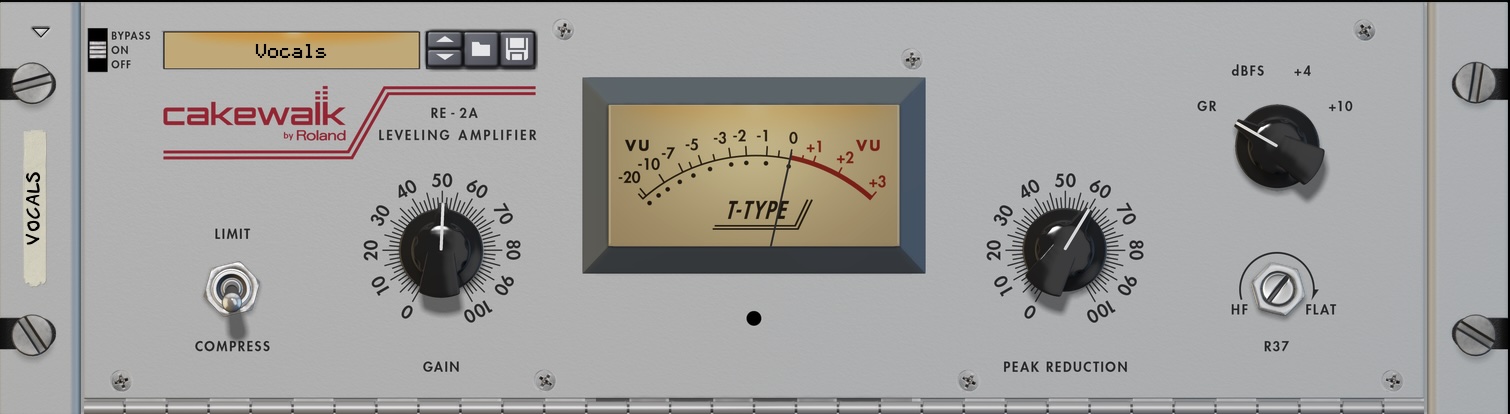
An emulation of the Teletronix LA-2A T-Type leveling amplifier (1965-69). The LA-2A is a tube-based feedback design (the compressor reacts to the output signal, not the input). It uses an electroluminescent panel together with a cadmium-sulfide light-dependent resistor to provide gain reduction (the "T4" cell). The properties of the T4 give the LA-2A its unique character by making it an entirely program-dependent design.
Described as "fat" and "warm", with minimal distortion.
DCAM BusComp
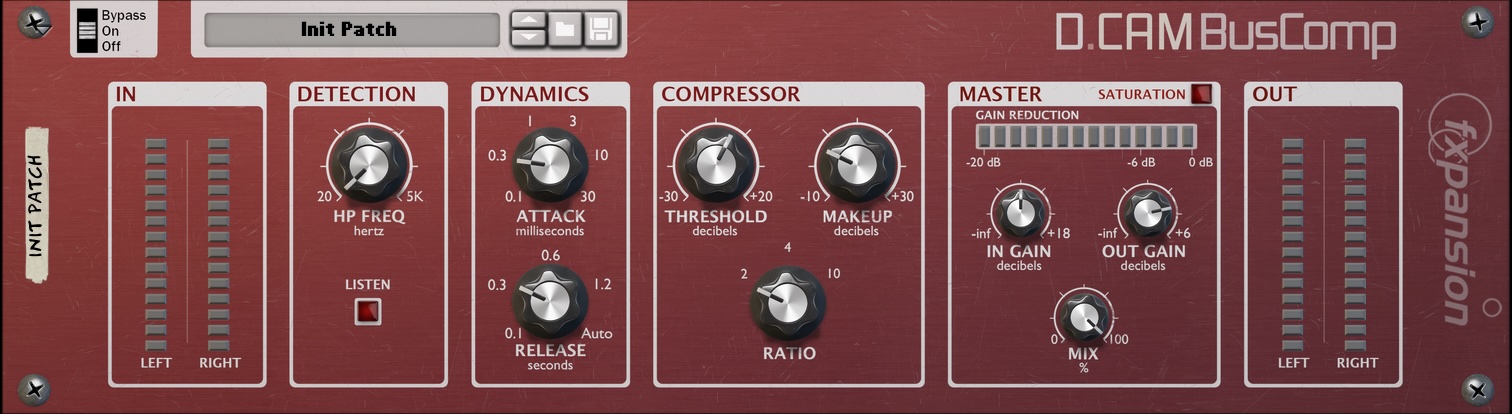
DCAM stands for "Discrete Component Analogue Modeling" - meaning that it attempts to emulate each component of the analog circuit. Like the Reason Master Bus Compressor, the BusComp emulates the SSL 4000 G.
Described as "Based on a classic bus compressor design from the centre section of a well-known British large-format mixing console."
DCAM ChanComp

DCAM stands for "Discrete Component Analogue Modeling" - meaning that it attempts to emulate each component of the analog circuit. The ChanComp emulates the 1176 Field Effect Transistor (FET) limiting amplifier.
Described as "a circuit-modelled channel compressor based on a classic FET-based limiting amplifier design."
kiloHearts Compressor

Described as "Someone somewhere once said that there are 931 compressor plugins in the world. Well, now there's 932!"
So, this is a basic but high quality compressor. I like the kiloHearts devices - they are simple but effective.
McDSP C670RE

Inspired by the Fairchild 670.
"The sound of the 660 and 670 is characterized by the complete absence of audible thumps, with extremely low distortion and noise. Both models feature an extremely fast attack time, producing the full limiting effect during the first 1/10,000 of a second."
Abbey Road Studios purchased 12 Fairchild 660s after staff engineer Peter Bown heard it during a visit to Capitol Records in America, and used it on recording sessions for the Beatles, primarily for vocals. Beginning in 1966, Geoff Emerick began using the 660 on Ringo Starr's drum tracks as well as piano and guitar tracks."
"...[W]e put the [drums'] sound through Fairchild 660 valve limiters and compressors. It became the sound of Revolver and [Sgt.] Pepper really. Drums had never been heard like that before." – Audio engineer Geoff Emerick on the Beatles' song "Tomorrow Never Knows"[12]
McDSP FRG 4RE

Described as a "feed-forward reactive gain compressor (FRG)... the FRG-4RE’s features include a modern compression topology, separately adjustable attack and release controls, and a wide compression ratio control spread, ranging from nearly 1:1 to 20:1"
McDSP MOO TUBE

Inspired by the Manley Variable Mu.
In a variable-mu compressor, the amount of amplification in a tube stage changes automatically as the input signal level increases. The term comes from μ (mu), the electronics symbol for a tube’s gain factor.
The compressor’s sidechain detects signal level and produces a control voltage. That voltage is applied to the grid bias of the tube. Instead of reducing level with a separate gain-reduction element (like a VCA or optical cell), the tube itself becomes the gain-control device.
Softube FET Compressor
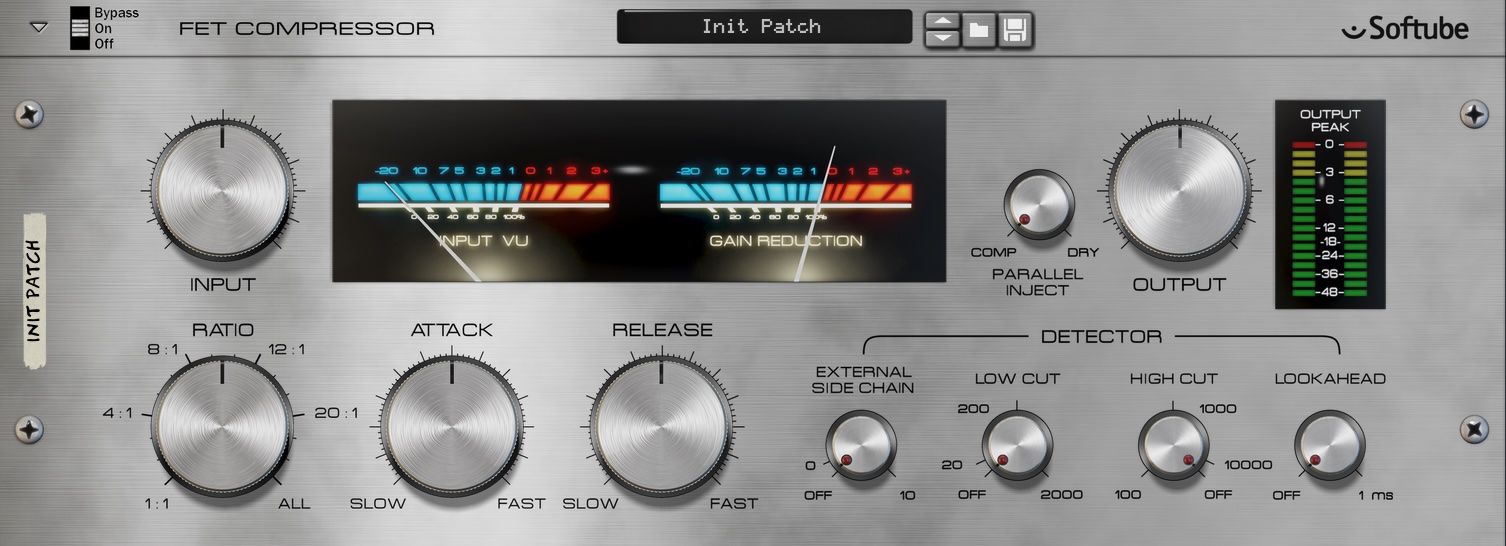
Inspired by the 1176 Field Effect Transistor (FET) limiting amplifier.
Fast attack, with a "bright character".